
February 2026. By Cecilia Campbell
Clarity is everything. At the start of 2026, a lot of things in the local media industry seem clear – if not all good:
- It’s clear that if you depend on traffic from search and social, pressure is mounting.
- It’s also clear that democracy across much of the world is under pressure and that the need for strong local journalism is as great as ever.
- It will have escaped no-one that AI plays a growing role in the news industry generally.
I suggest that we’re at an inflection point of these events. And that it may constitute a real opportunity for local journalism.
At the beginning of February 2026, OpenAI disclosed that ChatGPT gets over 1 million prompts a week relating to “local news” (covered by NiemanLab). Clever people were quick to dismiss it as insignificant as it only constitutes only a tiny fraction of all prompts. Of course it does.
But that’s not the point. There is another message here, beyond the numbers. And that is about what information the local queries are in search of. During the recent historic winter storm in the north east of the US, prompts about weather, disasters and school closures more than quadrupled according to OpenAI. Beyond special events like the storm, most local prompts are about “daily civic life: community events and local businesses, crime and emergency response, and legislation, courts, and public policy.”
Local media cover some of these topics of course. But there may be an opportunity here to claim a greater position at the heart of the local information ecosystem.
Let’s take a closer look.
The backdrop: Google referral traffic, AI and the role of local
1. Google – from frenemy to enemy?
Let’s start with one graph from the recently released 2026 edition of the Journalism, media, and technology trends and predictions report from Reuters Institute in Oxford. The graph, recreated in a more impactful way in an article by the Press Gazette, got more attention than most:
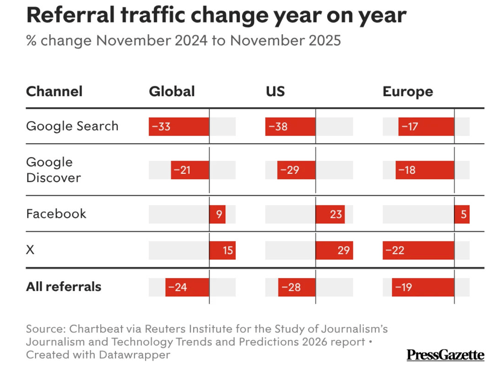
The dramatic drop in Google Search and Google Discover referral traffic generated a lot of discussion in the industry – how much further will this go? And how should publishers respond? Is it now time to really focus on driving direct traffic and foster loyalty and relationships with readers? Or should we double down on SEO or optimising for Discover (which is a different proposition)? I’ll return to this question.
As a side, the news industry’s relationship with Google is fraught on many levels – I recommend reading Danish media analyst Thomas Baekdal’s most recent contribution on the topic.
2. AI – more time freed up
It’s been over 3 years since generative AI became widely available. There were certainly news publishers who leveraged AI long before that, but there was a high degree of scepticism in the industry and uptake was relatively slow.
The recent Reuters report, based on a survey of 280 digital news leaders from 50+ countries, provides a view of how AI is now increasingly impacting newsroom work. The number of news leaders who rate various AI uses as important or very important for the coming year keep increasing. Most notably, the importance of coding and product development has increased by 16% since the last report.
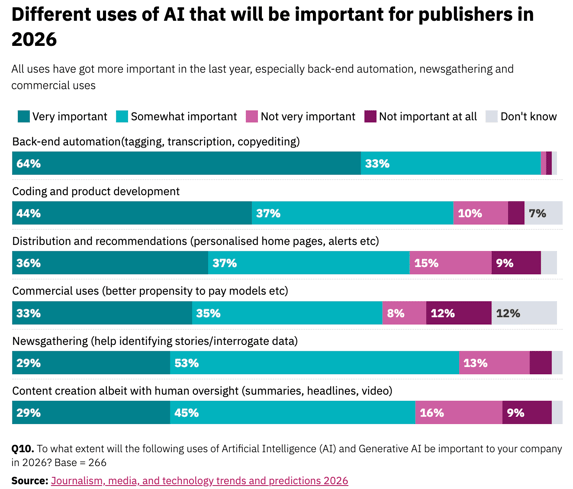
The increased uptake of AI tools has a particularly significant benefit for local newsrooms. With AI to help speed up basic newsroom tasks and even manage entire workflows, journalists can spend more time reporting out in the community.
3. The shift from story-centric to service-centric local media
In parallel with AI developments, there are also signs that local journalism is experiencing a shift in its purpose. Simply put, it's a shift away from a mindset of (reactively) reporting about communities, to one where we create journalism for our communities with a focus on being useful in readers’ everyday lives.
As local media veteran and current John S. Knight Journalism Fellow at Stanford Eric Ulken puts it in his contribution to the NiemanLab Predictions for Journalism 2026: “The new first question is not ‘What story do we want to tell?’ but ‘What problem are we solving, and for whom?'”
A concrete example of what this might look like: When an extreme weather event like a hurricane hits a community, local media doesn’t just report on the devastation, they also provide the key information people need, such as: what roads are closed and when they may reopen, when power is expected to be back up in affected areas, what gas stations are open, etc.
Everyday information that locals look for but that is often hard to find include e g: a way to track city hall decisions, school updates, traffic and road closures, building permit applications and approvals, event calendars, waiting times in the local emergency room, restaurant food inspections….
There are local media outlets who started working with the mission of solving problems a long time ago. Like the Bloomfield Info Project, a public service journalism lab in New Jersey, which I wrote about back in 2022. They identify information gaps around things like food distributions, free dental clinics for children and state aid for undocumented immigrants. Their journalism is not about publishing articles, but about providing local people with information services that help them in their lives.
On the E&P Reports podcast, George Adelman, director and head of partnerships at FT, recently discussed the findings of the new Local Media Playbook report published by FT Strategies in partnership with the Knight Foundation. The report looks at the lessons we can learn from thriving local newsrooms. Adelman said one thing strong local news organisations have in common is a focus on relevance and utility. He noted that much of the utility for readers was lost when legacy print products became digital. "I think a lot of organisations underestimated the service value of those products, over and above the journalistic quality within them. And I think with the transition to digital a lot of that value was unpacked and lost to other services on the internet.”
Some media outlets which lean into s ervice-centric journalism
> Village Media (founded in 2013) operates over 30 news publications in Ontario, Canada and beyond. CEO Jeff Elgie wrote on LinkedIn in December: “We are no longer just a media company. We are a Community Impact Organization.”
> The City in New York is a mission driven newsroom with “listening first” at the center of their model. They hear from locals in open-newsroom events and through targeted question intake via email and text message. Their output includes explainers, guides and investigations.
> Spotlight Delaware was founded in March 2024 and its mission is deeply rooted in community listening, engaging with marginalized groups to understand their news needs. This approach helps the team identify gaps in local coverage, particularly regarding government accountability, education, and land use, according to founder Allison Taylor Levine.
The intersection: AI turbocharges local information and data exploration
These two trends in local media – the leaning into service-centric journalism and AI – converge to potentially create much greater and more lasting impact for local communities. “The most interesting Al projects in local media share a common thread. They do not just make journalism faster or cheaper. They change what a news organization does for its community,” writes Ulrike Langer, publisher of the News Machines newsletter, in her article Local news starts becoming local infrastructure, part of the NiemanLab Predictions for Journalism 2026.
Just look at these examples (and there are so many more!):
> Hearst DevHub in the US is building AI tools for local newsrooms and local readers. Including the Houston Chronicle’s Meeting Monitor, which lets readers catch up on school district meetings and the search based Chowbot, which leverages archives of newspaper owned restaurant reviews.
> Lookout Local, a five year old digital news publisher in California and Oregon offers readers AI aggregated neighbourhood newsletters (among many reporter written/curated ones) with hyperlocal information such as crime and arrest reports, road closures, property redevelopment, property sales, restaurant food inspections and upcoming events.
> RussMedia in Austria has built AI Watch Dog, a newsroom tool which provides journalists with real time data alerts from continuous monitoring of specified sources for things like environmental alerts, political updates and government tenders.
> iTromsø, part of Norwegian Polaris group, has built DJINN (Data Journalism Interface for Newsgathering and Notifications). The tool extracts and summarises data and documents from municipal sources/archives and ranks them based on newsworthiness. This work was previously done by journalists, who now instead have time to go out and talk to people affected by the decisions made. End result – much more engaging journalism.
> Kansas City Star (McClatchy) publishes blog style traffic updates for specific routes like the K-10. The updates are generated using United Robots rules-based AI hooked up to a traffic data API.
The opportunity at the intersection of AI and service-centric journalism has the potential to be a game changer for local publishers and local people and businesses alike. The 1 million weekly ChatGPT prompts are an indication of an unfulfilled need for local information. And with Google Search traffic continuing to fall, it may be that there is a stronger position for local media to take. To not just be the frontline of holding power to account but also to be the backbone of the local information ecosystem.
Newspapers, after all, used to be the go-to-place for all things local. Perhaps it’s time to reclaim this space.