Scroll to top

News automation: The publishers’ treasure trove

We’ve been automating news since 2015 to fit with the business and journalism strategy of dozens and dozens of publishers. We have learnings to share.

This is our newsroom knowledge hub
– feel free to explore.

Categories

Introducing DataDesk: The local stories newsrooms never had time to find

Assuming your mission is to be an invaluable source of journalism – and information – to your local community, what is your strategy to achieve this? Where do you focus your resources and how do you prioritise?

Picture this. It's 9pm on a Tuesday, and a three-hour city council meeting just wrapped up. The county released a batch of building permits that morning. The local court published its weekly rulings at noon. The health department updated its restaurant inspection list. Nobody in the local newsroom read any of it. Not because it wasn't newsworthy — because there just wasn’t time.

That's the daily reality for many local newsrooms: small teams, endless local data, no realistic way to watch all of it. And even the stuff that reporters prioritize to look into is often difficult and time consuming to access.

AI, service journalism and the chance for local media to reclaim its position

February 2026. By Cecilia Campbell

Clarity is everything. At the start of 2026, a lot of things in the local media industry seem clear – if not all good:

  1. It’s clear that if you depend on traffic from search and social, pressure is mounting.
  2. It’s also clear that democracy across much of the world is under pressure and that the need for strong local journalism is as great as ever.
  3. It will have escaped no-one that AI plays a growing role in the news industry generally.

I suggest that we’re at an inflection point of these events. And that it may constitute a real opportunity for local journalism.

Unique local content and why it matters

What do readers have a right to expect from their local news publisher? This question of course has a lot of answers – from quality journalism to a useful UX. What I’d like to focus on here is something we at United Robots often discuss with our publisher clients; the importance of providing unique local content. Or – from the reader’s point of view – having access to a local news site that is the hub of local journalism and information that you can’t easily find anywhere else. The content that defines the community you live in.

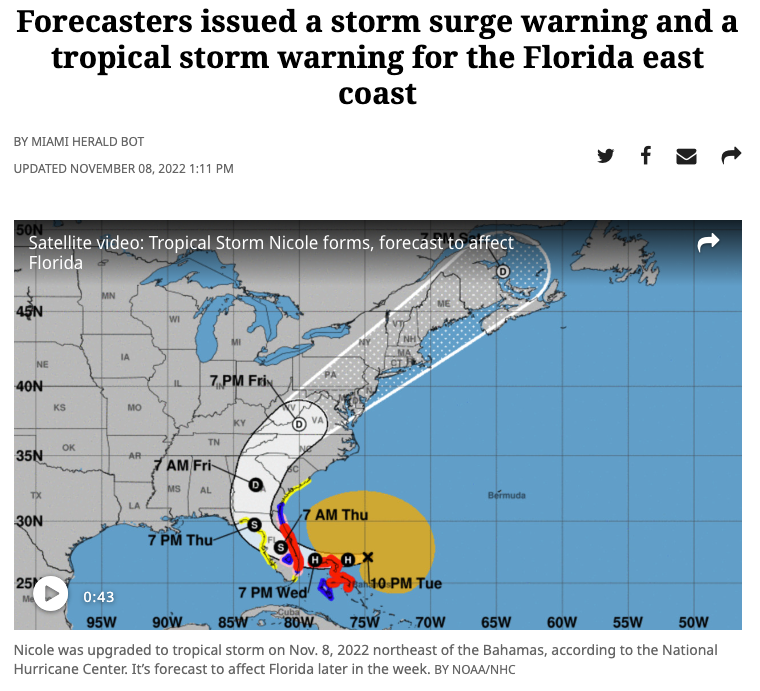
Weather warnings & Hurricanes: automated texts = instant + full local coverage

We know from local publishing partners how important it is to publish content that fulfills a need for local readers. With automated texts about extreme weather, local newsrooms can service readers with fast and reliable updates, and at the same time allow reporters to focus on covering live developments on the ground.

United Robots provides two automated weather content products: Weather warnings and Hurricane alerts. Weather warnings are based on data from the National Weather Service and our Hurricane product is built on data from the National Hurricane Center (more on products further down).

AI, liquid formats and the future of journalism

“We need to prepare for the death of the article as we know it,” said Nikita Roy at the Nordic AI in Media Summit* in Copenhagen recently. For me this was probably the most strikingly simple, yet clarifying statement made over the course of the two days – speaking, as it does, to a number of implications of the impact of AI on journalism. It’s about tech, but it’s also very much about people – those who produce it and those who consume it.

Weather warnings at Advance Local: triple win for the newsroom

Because automated editorial content is created from verified, structured data, it can safely be automatically published – from reliable data comes reliable text. This reliability lies behind a number of values gained in the newsrooms of Advance Local who publish automated weather warnings. During a seminar at INMA Media Subscription Summit in New York, Advance Local VP Content Strategy Lamar Graham and Matt Dowling, Director of Breaking and Local News at NJ Advance Media explained how the newsrooms work with, and benefit from, the automated content.

Advance Local’s venture into the use of automated content began in 2022, and had nothing to do with extreme weather. The media group has ten local markets, one of which is Massachusetts. There, the newspaper the Republican in Springfield had for a long time been publishing a listing of all the homes sold in Hampton County in print, collated manually from a spreadsheet. When they started publishing the same content online, they realised it was converting readers into subscribers, “and that’s when a light bulb went off,” said Lamar Graham. If they could replicate this type of content across many more markets, it would potentially amplify the effect. But having reporters manually put together lists to achieve a few hundred pageviews was not viable. “But what if we could somehow automate this and hoover up a bunch of this data around the country and scale it – that might be worth something. This was our hypothesis,” said Graham. Researching options, Advance Local came across United Robots and discovered we had already done the data hoovering and had automated real estate content production for the US in place (albeit from Malmö, Sweden). Advance Local started testing the automated real estate content at Masslive.com in 2022, and rolled it out to all other markets bar one in 2023.


Serving local communities with weather warnings meets a clear user need

We’re living through a summer when increasingly extreme weather events are impacting communities across the globe. Correct and up-to-date information is critical for people affected. For local publishers, this is an opportunity to make a real difference to your readers. Service them with reliable extreme weather updates, and they will likely start to come back to your site to stay on top of the situation and plan for what will come next.

Address

United Robots AB, Djäknegatan 9
211 35 Malmö

United Robots Data Policy

Social

Curious? Get in touch!